Tuesday, October 8, 2013

It just rained!

I walk by this particular residential complex everyday and often times (too often actually), the automatic sprinkler system is heavy in action during/immediately after a rain event. I decided I had enough and took some photos (see below). This just defies logic as I feel there was adequate rainfall. Not only is the timing so perfect, many of the sprinklers are directed towards the pavement, which means it is not being maintained. For example, as shown in the first two photos, in order for a pedestrian to access the sidewalk, he or she must become a target. There is also another location where the sprinkler is directed at an access drive (I didn't take a photo of that location, but will next time). Waste of water and adds to runoff. 


I think it's time to recommend looking into rain sensors and/or modifications to make it "intelligent". There are plenty of available technologies out there that can help conserve water, save on the utility bills and reduce runoff especially when additional water is not necessary. 

Wednesday, May 29, 2013

PE Exam Advice

Today, I found out I passed the Professional Engineer (PE) License exam I took this past April. 

State Board: New Jersey
Exam Type: PE - Civil
Exam Date: April 2013
Exam Result: Pass

That's all I needed to read - "PASS". Some advice for the future PE exam takers with the afternoon portion in water resources & environmental (I will be general, you have to sign an oath when you take the exam and I do not want to jeopardize my license in anyway or fashion):


  • Civil Engineering Reference Manual for the PE Exam (CERM) - This is a must have. Get very familiar with it, intimately familiar with your core afternoon subject chapters. Mine was obviously water resources and honestly, this book was all I needed. This is a great resource to have as a professional as well. Very thorough and detailed. I have already referred back to it a couple times to look up some equations. 
  • Take a review course - I took the School of PE weekend courses. We have so many things going on in our lives from working 'til you drop, managing friends, family, girlfriends, weddings, best man duties, yourself, personal issues, etc. On top of that, you now have to set aside time to rigorously study for the PE exam. Personally, I probably benefited most from the transportation review course mainly because I was never really interested in transportation. I'm not recommending a review course so that you can re-learn everything because that's not the purpose of a review course (if you need to re-learn everything, you are in trouble). Instead, I am recommending it because it keeps you focused. It gives you an excuse to block out your weekends. It preps your body to sit through eight hour days and practice problems. Plus, the instructors will provide you with a plethora of tips and keep you on a schedule. 
  • Schedule - Stick to some sort of schedule. I decided to focus heavily on my core area first for the afternoon depth portion. Afterwards, I did as much as I can to refresh and go through the materials for the morning subjects (geotechnical, transportation, structural, etc.). School of PE definitely helped me pace myself on the morning topics. 
  • Pack light if you can - I brought the CERM, one water/wastewater treatment book, Review Course binder and a civil engineering dictionary. When I went to the exam site, I thought I was at an airport. You will know what I mean. Unless you are taking an afternoon subject that requires multiple, multiple codes, I would recommend packing light. At that point, if you don't know it, you don't know it. Time management is key and the CERM is extremely thorough and detailed. 
  • Tab, Tab, Tab - Make sure you know where to flip to. Time management is key!
  • Practice, Practice, Practice - Finding time to study was very difficult. So, I made sure when I did, it was effective. I went through my core subject areas and other areas that I could in the CERM Manual. Afterwards, I practiced as many problems as I could (not just solving to solve, but actually being able to think through and solve it). The Six-Minute Solutions, NCEES practice problems, CERM example problems, review course problems, etc. are all great resources. Also, when you practice, practice with the materials you plan to bring and in the same condition. For example, if you are going to bring materials binded, practice with the materials binded. You want to be extra comfortable with your materials.
  • Exam mentality - Read and solve what the problems ask. The exam is testing you on your engineering fundamentals. You are going to be sitting through eight hours so stay focused  and read the problems carefully. I hate having to be on exam mentality, but you have to do it. There were plenty of times when I was studying and I would breeze through practice problems thinking it was so easy only to find out I was wrong. I did not read what the question asked for. Simple as that.
  • Check your units and significant digits - Straight forward. Read the first couple pages in the CERM on significant digits. 
  • CERM Index - Have a separate binded copy of the CERM Index. Much easier to look up during the exam. 
  • Calculator - Make sure you are using an approved calculator from the NCEES website and purchase a backup. Use the calculator when you are practicing. I was so used to using TI-86 that I needed to get familiar with the approved Casio ones.
  • After the exam -  Get some sleeeeepppp! Then, grab some drinks! You just sat through a grueling eight hour exam. I wouldn't think much about it afterwards and move on with your life until the results come in. 
Anyways, just my two cents! The exam covers a lot of material so don't be overwhelmed and have an honest self-assessment of where you stand. Believe and trust in yourself, only you will know when you are ready. 

Good luck to all the future PE examinees and congratulations to all the new April 2013 PE's!


Friday, May 17, 2013

The Knack

If an engineer loses the knack, results can be devastating...


Food for thought for our profession.


Friday, May 3, 2013

Sunday, December 23, 2012

NHL and Sustainability

Sorry, I have been meaning to create a post about this much earlier. 

NHL GREEN! 


This was big for me when I first read the news because hockey is and will always be a major part of my life. Definitely a great move for the league and the move towards a more sustainable earth. 

Major steps and programs developed so far include: 
  • Water Restoration Program
  • Recycle the Game
  • Gallons for Goals
  • Legacy Tree Project
Major partners:
Mike Richter (former elite goaltender of the New York Rangers) has a huge part in this initiative as a dedicated water resources advocate. Two years ago, I attended the American Water Resources Association (AWRA)'s annual conference in Philadelphia (ironically in Philly - yes, I am a die hard Rangers fan) and he was the keynote speaker. It was amazing to see my hockey idol speak so passionately about the challenges we face in water resources today. Only if he stopped by our technical poster presentation. =(


2010 AWRA Conference

It will be cool to see what positive impacts NHL GREEN will continue to make from energy efficiency, water conservation, re-use, stormwater retrofits, etc.

"There is a perfect intersection between the environment and human health,"  Richter said "It should not be considered a rare thing for sports to be talked about in the same breath as the environment." Richter addressed the League's pursuit of practical, cost-effective solutions to ecological issues, citing the establishment of the NHL's metrics tracking system, which is designed to capture and analyze a facility's energy, water and waste data. "We need to make our buildings as efficient as the athletes that use them," Richter said.

Now, only if the NHL can figure out how to resolve this lockout issue and get the season started! Let's go Rangers!

For more information, check out the following link:


Friday, December 21, 2012

Hurd Field PP

It's been awhile!

Link to a presentation on the recently constructed (September 2012) porous pavement retrofit project in Arlington, MA. The goal of the project was to provide water quality improvements for an existing parking lot adjacent to a waterway. 


Cross-sectional View of Porous Pavement System used at Hurd Field
Source: http://www.epa.gov/mysticriver/porouspavementproject.html

Good start to finish type presentation with useful data as well as nice photos to put things into perspective. I liked the last bullet on the presentation: "Pre-design - good understanding of soil mechanics and engineering (if incorrectly situated, performance and reputation suffer)". 

Very true and highlights how important site selection is. In addition to site selection and a good understanding of the subsurface conditions, it is important to have a grasp on the anticipated traffic volume, anticipated vehicle types and loads, etc. to spec the proper mix as well as determining the porous pavement thickness. Then, it's all about the maintenance!


Wednesday, October 17, 2012

"Long Live Civil3D"

As my colleague would say "Long live Civil3D"!!

Short and to the point. This goes back to my previous post about how we have been blessed with technology. From the get-go of my career, Civil3D has been there by my side. I thought I should pay tribute especially since I've been working on some heavy duty grading lately. From site grading tools to earthwork estimates to profiles to pipe networks to river hydraulics to floodplain mapping, it has been there for me. =)


Good night!

Friday, October 5, 2012

Stormwater Wetlands (VIDEO)


Stormwater Wetland in the Bronx

Nice video on the newly constructed stormwater wetland at the New York Botanical Gardens. According to the NYCDEP Press Release, Southern Boulevard was subject to frequent flooding in the past among other related issues. Now, new catch basins have been installed to convey stormwater runoff into the constructed stormwater wetland prior to discharging into downstream waterbodies. 

  • Reduction of urban flooding - CHECK 
  • Treatment of stormwater runoff at the source - CHECK 
  • Reduction of downstream erosion - CHECK 
  • Reduction of CSO - CHECK 
  • Creation of open space - CHECK 
  • Increase in habitat diversity - CHECK 
  • Educational Platform - CHECK


Marrying natural principles in urban settings is what green infrastructure is all about. Enjoy!

Sunday, September 30, 2012

Civil Engineers Part II


Check out the news article above (click the link). Sounds like good news! I know many fresh graduates have been struggling in this market, but apparently "the job outlook is promising for civil engineers". 

While I was reading the article, I thought I'd create a post and share some of my limited insight for newly graduating civil engineers (this is just my opinion and views). 

We all know as civil engineers (as stated in the article above as well), you need to be very strong in mathematics and science. It is extremely important you are an analytical thinker, detail-oriented, have clear communication skills and the list goes on and on. These are must-have skill sets you need to bring to the table. As you hone your skill sets to become a civil engineer, also consider the following advice, which  I feel are not emphasized enough or at all. 

Area of Specialty
Find it! Do whatever is necessary to find your area of interest. Civil engineering is a very broad field. Civil engineering branches off into multiple disciplines such as water resources, transportation, geotechnical, structural, etc. Within these multiple disciplines, it branches off into  further specialty areas. Gone are those days when a civil engineer can be "the jack of all trades". Yes, our civil engineering fathers were able to do it. It is mind boggling how to this day, we are using the theories and equations developed by these geniuses who never had the luxuries we take for granted - technology. 

I believe finding your "area" is very important and the earlier, the better because quality experience is important in our career. If it wasn't for my early internship experience, I would have never found my passion for water resources. When I was a freshman, I thought civil engineering = structural engineering. 

Pay Attention in College
Sometimes, I hear experienced engineers telling younger engineers that you never use what you learned in school. 

I strongly disagree. Pay attention to the fundamentals taught by your professors. We are supposed to be strong thinkers and problem solvers. Knowledge is power in our industry. We have been blessed with technology, however, without understanding the fundamentals and where and what equations you are using and how it is being applied and derived from, you would simply be "plugging and chugging" a.k.a blindly inputting numbers. Garbage in = garbage out. 

Advice: save your textbooks, at least the ones that are focused on your discipline.

Find a Mentor
It is important you find a mentor especially in your young career. Unfortunately, finding that mentor may not be easy or available. A mentor would provide you with valuable inputs from his or her experience, sound technical advice, career advice, etc. Don't mistaken this person to be someone who you expect to spoon-feed you in your career. No one is going to spoon-feed you. Your engineering career is ultimately up to you. 

Passion
This one is, in my opinion, the most important. This probably applies to all professions as well. I feel this is not stressed enough for civil engineers. Without it, you will not survive in this industry because you won't enjoy it. There will be many times of high stress, high demands and pressure, long hours, etc. And let's face it, everyone cares about salary and there are people that are in it for the money. Well, let me tell you what they don't tell you in undergrad. You're not going to be making banker money. You really have to enjoy what you do. As a civil engineer, you have great responsibilities that will have an impact on society. You will deal with complex problems that you need to solve (sometimes may even bother you so much you can't even sleep). The reward may not (will never) be a million dollar bonus, but you will know you are part of a profession planning and designing the infrastructure our society can't live without. 

Just my 2 cents... this post is a work in progress. I will continue to add to it. 

Friday, September 28, 2012

It just won't work...

Hello everyone, 


My blog probably screams green infrastructure. There has been so much hype and many regulatory agencies now require developers to incorporate it into the design. As much as I am a proponent of it, there are times when it just won't work! You can't just blindly place bioretention areas, rain gardens, porous pavement, bioswales, etc. all over your site because it's cool or it's good marketing. Without strong investigation of the soils and site conditions and even longer term maintenance considerations, it can FAIL! 

The major component is infiltration. If the underlying soils are poor in terms of infiltration (generically speaking - C and especially D soils), how will infiltration work? If you have shallow groundwater, your system may be saturated at all times (hence groundwater separation). Also, on a volume based approach, remember you are not going to be detaining runoff generated from the 100 year storm event. You would be using these techniques to meet WQv requirements (in New York State, 90% rule), especially for bioretention areas, etc. Rule of thumb on volume based approach is the 95% rule (rainfall events < or = to the 95% percentile event). Another important consideration is your surrounding infrastructure. 

It's a bummer though when you have a large site with so much space for green infrastructure implementation, but its all C and D soils and after numerous boring logs, groundwater data and perc tests to confirm, it's just not feasible. Also, keep in mind that subsurface investigation needs to be well prepared. I remember one time when my geotechnical professor said to be very careful when encountering perched water table. It is very true. 

Anyways, a solid site assessment and early planning is key. Also, once it's successfully designed and installed, it's not over! Maintenance.... ooh.... the dreaded word.... I know most people hate the word maintenance like oil changes for a car. But this is a commitment to a more sustainable environment!

There was a good post on LinkedIn related to this matter titled "can green storm water designs aggravate basement flooding" under the Sustainable Stormwater Group. You should check it out. A lot of great points made in the discussion thread. 

Monday, September 10, 2012

Green Infrastructure Courses offered in NYC


Green Infrastructure Courses offered by Pratt Institute in NYC. I haven't seen a curriculum focused specifically on green infrastructure before. Pretty cool, eh? I tried attending one of the courses earlier in the year, but it was cancelled last minute. The program is being re-offered for the Fall semester.

Link to the course registration: Pratt Registration


Sunday, September 9, 2012

The Lost Valley


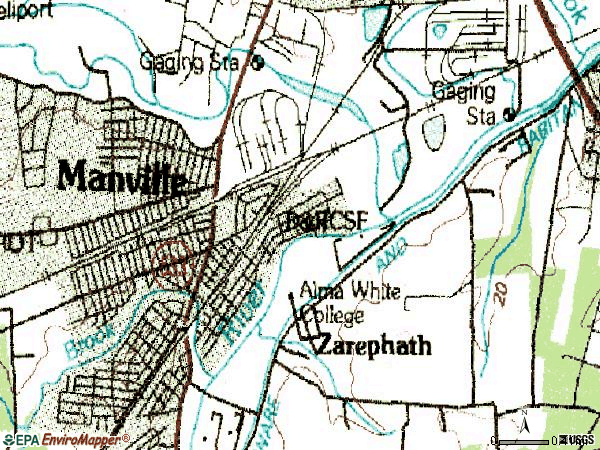
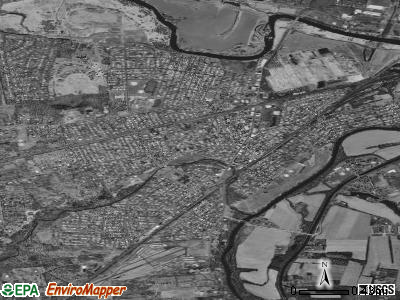
I was reading a blog post on New Jersey Infrastructure and came across this video titled "The Lost Valley: Rising Water, Sinking Hopes" focusing on the serious flooding issues at the Borough of Manville in Central New Jersey. It's a very sad and a very real problem. According to the National Flood Insurance Program (NFIP) statistics, floods are the number one most common natural disasters in the U.S. 

Borough of Manville - USGS Quad Map
Borough of Manville - Aerial Imagery
As you can see on the images above, the Borough is surrounded by waterways: the Raritan River, Millstone River and Royce Brook. The "Lost Valley" is the eastern portion of the Borough bounded by the railroad tracks and Millstone River. I remember awhile back, I was in nearby Bound Brook taking water quality measurements during a heavy rainfall and it was rough - local roads and properties flooded, bubbling manholes, etc. I remember the water surface elevation was just flirting with the low chord of one of the bridges I was taking measurements from. Serious stuff. 

Well, check the video out if you haven't already. A well-made video on promoting awareness of a very serious problem. 


Tuesday, August 7, 2012

Rain Tax

"Your Stormwater Dollars"

Hi All,

I came across a simple, yet effective video on stormwater (see above) developed by the City of Durham in North Carolina. I thought it was a creative way to explain the effects of urban stormwater to the general public. Everyone loves cartoons and visuals! Often times, many engineers and scientists (engineering stereotypes must have stemmed from somewhere) become enmeshed in the technical details without being able to clearly convey the message. I'll admit, at times it happens to me as well. That's when I think of Tiger Woods saying "K.I.S.S. = Keep it Simple Stupid". Okay, I really don't think of Tiger Woods, but you get the point.

Anyways, the purpose of the video is to explain to the local citizens the reason for the City of Durham's stormwater tax and where all the money goes. Honestly, this is pretty new to me, mainly because we do not have a fee or tax directly supporting the maintenance of stormwater infrastructure in the city I reside in. But, from what I am researching online, there are several local municipalities throughout the U.S. imposing a tax for stormwater services. In general, the tax rate is directly related to the amount of impervious areas within a property/residential unit. Well, this topic is very controversial so I won't dive deeper. All I will say is, stormwater infrastructure is very important!

http://www.cityoftyler.org/Portals/0/uploads/departments/Stormwater/Images/About_Stormwater.jpg
Source: http://www.cityoftyler.org

Enjoy!


Tuesday, July 10, 2012

Raindrops Keep Fallin' on my Head...

Random, but related...

Passaic River Basin Flood Preparedness Workshop
Very good presentations from the workshop focusing on the Passaic River Basin. Check out the link above. Presentations by the speakers can be downloaded by clicking their names (it took awhile for me to figure that out...). Many topics focusing on green infrastructure. 

From Presentation "USGS Involvement in the PRB" by Heidi Hoppe

I was reading an interesting article titled "The Energy Balance Method of Stormwater Management" from this month's STORMWATER MAGAZINE when this image captured my attention:
This office complex is on green infrastructure steroids! It's the Wetland Studies and Solutions, Inc.'s HQ building in Virginia. For more information, check it out on ASCE.

By the way, if you are a stormwater professional and have not subscribed to the Stormwater Magazine, you definitely should. Great articles and best of all, it's FREE! STORMWATER

Until next time, good night or good morning?


Thursday, June 28, 2012

Dredge Baby, Dredge!

I was cleaning out my old laptop and found some of my dredging photos/videos from back in grad school. I've been working on a lot of dredging projects as of late so I thought I'd share!

What is dredging? It is basically excavation underwater (e.g., in rivers, bays, etc.).

 Source: http://huron.lre.usace.army.mil/

There are several types of projects involving dredging work. Some examples are:
  • Remedial dredging for removal of contaminated sediments in the waterways; 
  • Capital dredging to increase depth of navigation channels/harbor access channels to accommodate for deep-draft ships (more cargo = more $$);
  • Maintenance dredging to remove accumulated sediments in navigation channels in order to maintain channel depths. 
Here are some photos/videos I "dredged" out of my laptop. I believe this was in Port Newark area. This monster is a mechanical dredge. I have yet to meet a hydraulic dredge in person. =)

Photo of the clam shell bucket in action:


Photo of the bucket in open position:


View from the Operator's Seat:


Video of the port cranes in action (Tom Cruise is operating it):


Photo of your goodies! Wonder how much that is worth?:


Remember, Safety First!


ENJOY!

Sunday, June 24, 2012

What does Linkin Park and Wetlands have in common?

Answer: Nothing. My creative attempt at getting more viewers. =)

I stopped by the Lincoln Park Wetland Restoration site today in Lincoln Park, Jersey City, NJ. This is one of the projects I worked on in the past, but I never really had the time to stop by after it was constructed. Today was the day (photos can be found at the end of this post).

Brief Background on the Lincoln Park (LP) Wetland Restoration Project
The LP site (approximately 40+ acres) is a restored tidal wetland complex off the Hackensack River in Jersey City, NJ.

Here's a very brief history of land use:
  • Existing salt marsh.
  • Illegal dumping activities convert site to a landfill/dredged material disposal site.
  • Restored back to a salt marsh (LP Wetland Restoration Project).
This innovative project consisted of proper landfill closure, wetland/habitat restoration, pond restoration, beneficial reuse of dredged material suitable as a planting medium, etc. Additionally, a 9-hole golf course is currently in the process of being constructed adjacent to our LP wetland site. I can't wait to play on that course when it is constructed!

Overall, the LP Wetland Restoration project is a great example of urban sustainability and is one of the projects I am proud to have been a part of. An "ecological oasis right outside of NYC".

Photos I took of the site prior to LP Wetland Restoration:


Photos I took today (6/24/2012):


Here is an aerial photo of the site:


 Here are some links if you would like to read more into the project:
Enjoy!

Wednesday, June 13, 2012

Porous Pavement Trail in Albany, NY

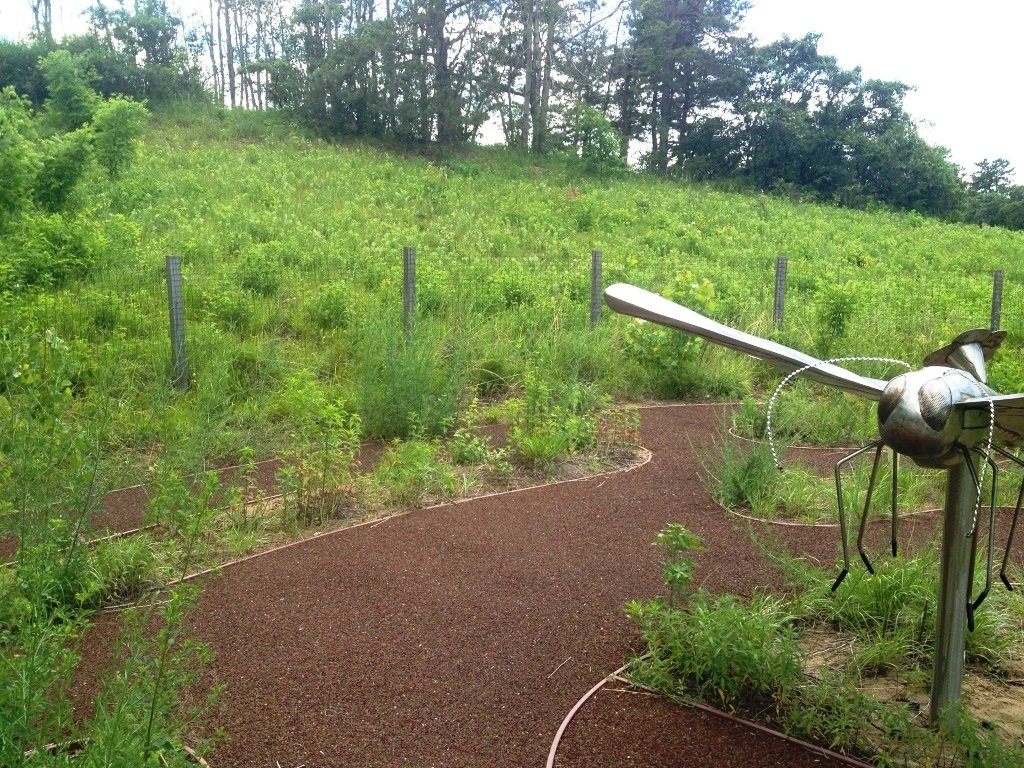
I stopped by the Albany Pine Bush Discovery Center today since it wasn't too far from my hotel. The site has some porous pavement trails that I wanted to check out after looking into some green infrastructure sites in the Hudson Valley. Based on information available from the NYSDEC website, this type of porous pavement mixture includes recycled tires. The function is the same concept as I discussed in my previous post, except the mixture may differ especially for proprietary products such as this one. There are many others as well that involve the use of recycled glass, etc.

For more information on this site, see this link: NYSDEC Albany Pine Bush Discovery Center Porous Pavement.

I am now off to my vampire oversight shift!

 Here are some photos I took:


Enjoy!

Sunday, June 10, 2012

Civil Engineers

I am currently at a Starbucks in Upstate NY (my only day off). As I briefly mentioned in my previous blog, I am up here conducting oversight for a major project. There isn't much to do near my hotel (this place is filled with generic chain restaurants, shopping centers, etc.) so I will post.

For this post, I will re-circulate what our 31st president, Herbert Hoover, had to say about civil engineering:
"It is a great profession. There is the satisfaction of watching a figment of the imagination emerge through the aid of science to a plan on paper. Then it moves to realization in stone or metal or energy. Then it brings jobs and homes to men. Then it elevates the standards of living and adds to the comforts of life. That is the engineer's high privilege. The great liability of the engineer compared to men of other professions is that his works are out in the open where all can see them. His acts, step by step, are in hard substance. He cannot bury his mistakes in the grave like the doctors. He cannot argue them into thin air or blame the judge like the lawyers. He cannot, like the architects, cover his failures with trees and vines. He cannot, like the politicians, screen his shortcomings by blaming his opponents and hope that the people will forget. The engineer simply cannot deny that he did it. If his works do not work, he is damned. That is the phantasmagoria that haunts his nights and dogs his days. He comes from the job at the end of the day resolved to calculate it again. He wakes in the night in a cold sweat and puts something on paper that looks silly in the morning. All day he shivers at the thought of the bugs which will inevitably appear to jolt his smooth consummation. On the other hand, unlike the doctor his is not a life among the weak. Unlike the soldier, destruction is not his purpose. Unlike the lawyer, quarrels are not his daily bread. To the engineer falls the job of clothing the bare bones of science with life, comfort and hope.

No doubt as years go by people forget which engineer did it, even if they ever knew. Or some politician puts his name on it. Or they credit it to some promoter who used other people's money with which to finance it. But the engineer himself looks back at the unending stream of goodness that flows from his successes with satisfactions that few professions may know. And the verdict of his fellow professionals is all the accolade he wants."
So far in my young career, I have been fortunate to see some of the projects I worked on become a reality. I must admit, when you see your calculations, designs and all your late nights and hard work pay off, whether the project is big or small, the feeling is priceless.


 Image Source: http://civilengineerlink.com

How come I never get to wear a business suit to a project site? =)

- e|3


Wednesday, June 6, 2012

"Build a Rain Barrel" Workshops in New Jersey

There are workshops being held in NJ this week and next week on building rain barrels. Check it out on this link - Build a Rain Barrel.

Rain barrels at your home (if you have one) can be an inexpensive, simple way to harvest rainwater for various non-potable uses such as watering your garden, etc. It could save you some money on the bills and provide you with an opportunity to contribute in combating local flooding.

Image source: lastormwater.org
- e|3